
Vermilion Bird
F1 simulator
IMMERSIVE EXPERIENCE
Vermilion Bird F1 simulator provides immersive experience and professional training for those who love racing, making F1 racing a part of daily life!

Longer service life (Reliability)
Under rated load, the full stroke reciprocating working life is not less than 5×10^7 times
The life should not be less than 10 years (average operation of 8 hours per day); can work continuously for 24 hours!

Excellent Movement performance
Our engineering team meticulously equipped it with a 1600W high-power motor, a high-speed electric cylinder (10mm lead screw pitch),and an exclusive custom servo controller. Just like a true Formula 1 car, having the most exhilarating and reliable power system iswhat every racing driver dreams of. And for a racing simulator, the high-performance servo controller is akin to a perfectly tunedsuspension system in a real race car.It flawlessly simulates cockpit pitch, roll, and other movements, replicating the vehicle's undulations, bumps, and rear-end dynamics.This precise motion system faithfully recreates all the jolts and reactions of a race car on the track, greatly enhancing the driver's experience.


4.3-inch Built-in Digital Dash
A 4.3-inch built-in digital dash with 800*480 resolution display all the essential info racers need to know in the heat of competition.

Makes throttle control easier and brake more accurate
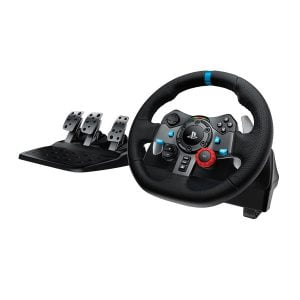
The MOZA SR-P pedals utilize pressure sensors with a maximum range of 75KG. The pressure sensors will detect the braking pedal stopping pressure .
A user can obtain the ideal braking force by controlling the amount of pressure applied on the braking pedal.


The MOZA SR-P pedals utilize pressure sensors with a maximum range of 75KG. The pressure sensors will detect the braking pedal
stopping pressure . A user can obtain the ideal braking force by controlling the amount of pressure applied on the braking pedal.
Dual Sensor Fusion Algorithm
The brake utilizes a pressure and angle sensor, allowing fine tuning of braking. The initial stage is dominated by the angle sensor, allowing racers to control the braking angle,
the mid and last stage is controlled by the pressure sensor, which makes the pedal easier to control.


HIGH-QUALITY FIBERGLASS CAR BODY
High-quality fiberglass materials should have excellent tensile and flexural strength, capable of withstanding significant mechanical stress without breaking or deforming. A smooth surface not only
enhances the material's appearance but also reduces friction and wear. It should also be resistant to chemical corrosion, moisture, saltwater, and other harsh environmental conditions.